
Morse Code Translator & Generator Online
Type a message above in our Morse Code Translator, and the dots and dashes show up as you go. Paste in dots and dashes instead, and you get English back.
Press play and you can hear it too, short beeps for dots, longer ones for dashes.This free, online Morse code translator works instantly in your browser, no downloads, no sign-up, no waiting.
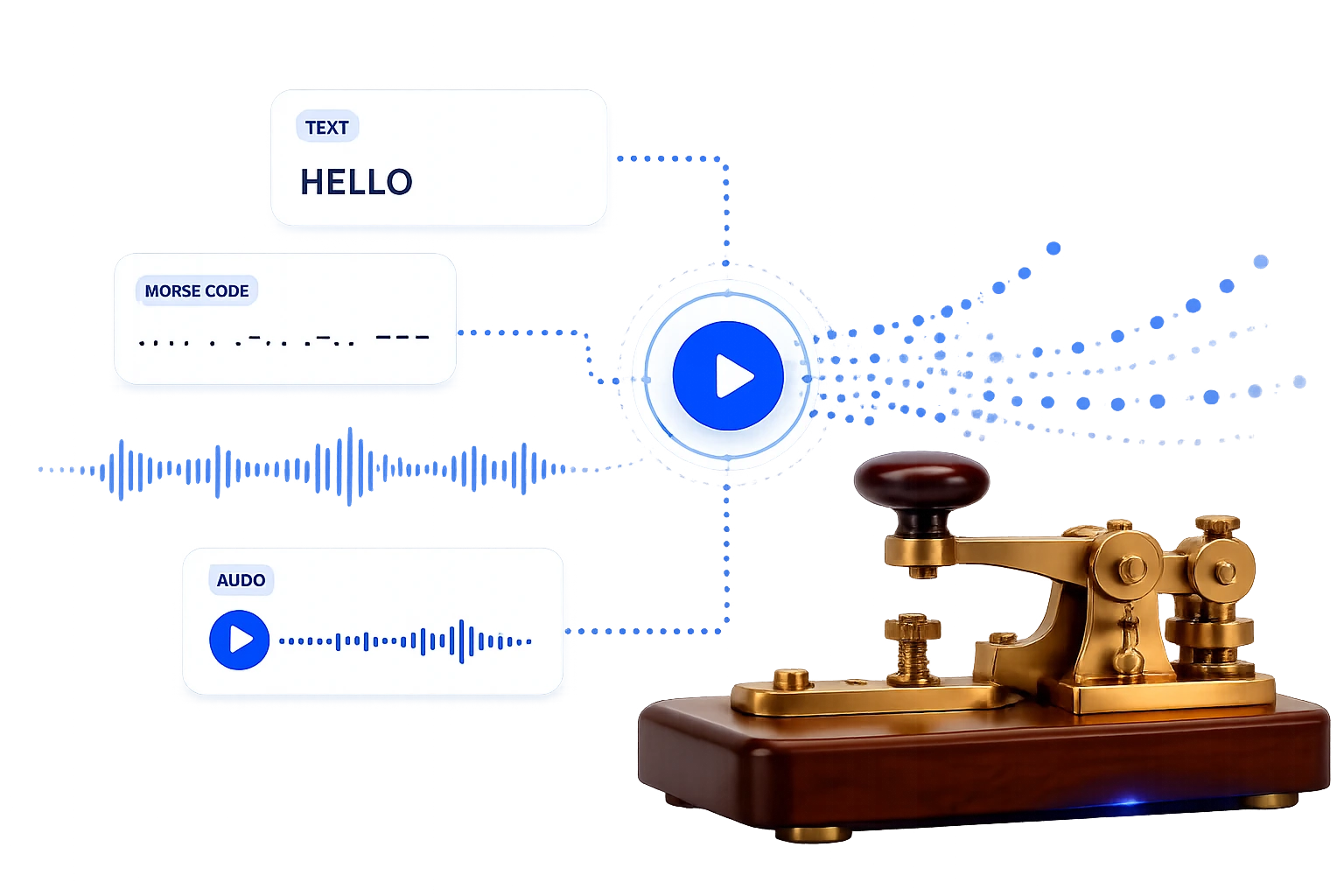
What is Morse Code?
Morse code turns every letter, number, and punctuation mark into just two building blocks: a short signal and a long one. We call them the dot and the dash. Samuel Morse worked out the original version in the 1830s, and his collaborator Alfred Vail helped shape it into the practical system telegraph operators relied on for decades. The version still used today, International Morse Code, was later standardized by the ITU, so the same dot-dash timing works the same way anywhere in the world.
It never disappeared because it asks for so little. A dot or a dash can travel as sound, light, a tap, or a deliberate blink. Phone lines go down, internet connections drop, power grids fail, and Morse code keeps working anyway.
A Morse code translator like this one just automates both directions of that process, text into pattern on one side and pattern back into words on the other, with sound built in so you can hear it instead of only reading it.
How to Use Morse Code Translator
There are three steps to use the Morse code translator, and most people have it figured out within a minute.
Type Your Message
Drop plain English or a string of dots and dashes into the input box. The tool figures out which one it’s looking at without you flipping a switch first. Letters, numbers, and the punctuation people actually use in real sentences are all supported.
Instant Translation
Type, and the output box fills in as you go. Text becomes dots and dashes, Morse becomes readable English, no delay, no separate convert button to hunt for.
Listen, Watch, or Decode a Photo
Press play to hear the result as real Morse audio. There’s also a flashing light option that mirrors how operators historically sent code across distances with lanterns or signal lamps, and an image decoder.
Learn the Morse Code Alphabet, Numbers, and Symbols
Memorizing 26 letters by brute force doesn’t stick. Learning by pattern, sound, and repetition does.
The Complete Morse Code Chart (A to Z, 0 to 9, and Symbols)
Three quick reference tables cover everything you need for everyday messages. Keep them open in another tab while you practice with the translator above.
Learn the Patterns, Not Just the Dots
Stop memorizing 26 random combinations. Start noticing the structure underneath them, and the alphabet stops feeling random.
- 1
E (.) and T (-) need only one signal each. Start here.
- 2
S (…) and H (….) are built entirely from dots, with no dash breaking the rhythm.
- 3
A (.-) and N (-.) are mirror images of each other. Learn them as a pair.
- 4
Numbers scale predictably: more dots near the front means a smaller digit, more dashes near the front means a larger one.
Don’t Forget Punctuation. A question mark, a comma, or a period changes how a message reads. Skipping these is one of the most common gaps in beginner practice, so once the alphabet feels solid, spend a short session on the punctuation chart.
How Does Morse Code Work?
Every character has one fixed sequence of dots and dashes that never changes, which is why the system stays reliable across languages and operators decades apart. The real skill isn't counting symbols, it's recognizing the shape of a letter the way you'd recognize a face.
A-Z Chart
The complete alphabet, A through Z. Worth bookmarking if you're just getting started, since this chart backs both encoding and decoding.
| Letter | Morse Code | Letter | Morse Code |
| A | .- | N | -. |
| B | -... | O | --- |
| C | -.-. | P | .--. |
| D | -.. | Q | --.- |
| E | . | R | .-. |
| F | ..-. | S | ... |
| G | --. | T | - |
| H | .... | U | ..- |
| I | .. | V | ...- |
| J | .--- | W | .-- |
| K | -.- | X | -..- |
| L | .-.. | Y | -.-- |
| M | -- | Z | --.. |
Numbers Chart
This built-in Morse code number translator makes it easy to look up any digit fast. Numbers follow a tighter pattern than letters once you spot the trick. The first five digits build up dashes one at a time, starting from all dots. The last five mirror that in reverse, building up dots starting from all dashes. Zero sits by itself: five dashes, nothing else.
| Number | Morse Code | Number | Morse Code |
| 0 | ----- | 5 | ..... |
| 1 | .---- | 6 | -.... |
| 2 | ..--- | 7 | --... |
| 3 | ...-- | 8 | ---.. |
| 4 | ....- | 9 | ----. |
Characters Chart
Punctuation shows up less than letters and numbers, but it's what lets a full sentence land with its grammar intact.
| Symbol | Morse Code | Symbol | Morse Code |
| Period (.) | .-.-.- | Comma (,) | --..-- |
| Question mark (?) | ..--.. | Apostrophe (') | .----. |
| Slash (/) | -..-. | Hyphen (-) | -....- |
| Parentheses ( ) | -.--.- | Colon (:) | ---... |
| Semicolon (;) | -.-.-. | Equals (=) | -...- |
Spacing Rules
A run of three dots only means S if the silence around it is the right length. Make the gaps too short or too long, and you've got three separate E's instead. International Morse solves this with three fixed pause durations.
| Pause Length | What It Separates | Example |
| 1 unit | Dots and dashes within one letter | S = . . . |
| 3 units | One letter from the next | S O S |
| 7 units | One word from the next | HELLO WORLD |
If you ever lose the rhythm while listening, just remember a dash runs three times as long as a dot. That's the one ratio worth keeping in your head.
Features of This Morse Code Translator
Small details add up to a tool people actually want to use daily. Here's what's built in.
Convert Text to Morse Code
Drop a sentence into the text field and watch the dots and dashes build as you type, no lag waiting for a button. The full alphabet, all ten digits, and everyday punctuation are covered, so a real sentence comes through whole instead of stalling on the first character the tool doesn't recognize.
Real-time ConversionTranslate Morse Code to Text
Switch direction and paste Morse code into the input box to decode it back into English. Letters need a single space between them, words need a forward slash. This is the half of the process most other tools treat as an afterthought, even though decoding is genuinely the harder skill to build.
Accurate DecodingCopy and Share Instantly
Both the text and Morse outputs have a one-click copy and paste button, so a translation drops straight into a message, a document, or a social post. A share option sends the result to someone else without retyping anything.
One Click CopyGenerate Random Messages
A random message generator gives you a fresh word or short phrase whenever you need a quick practice round, or want to stress-test your decoding speed without thinking up your own test sentence.
Endless PracticePlay Morse Code Audio
Press play to hear your message as real Morse sound, short beeps for dots, longer ones for dashes. Audio is the fastest way to connect the visual pattern with the actual rhythm operators use on the air.
Real Morse SoundVisual Light Playback
A light mode flashes on screen in sync with the audio, recreating how Morse was historically sent with lanterns or signal lamps. Visual learners often pick up rhythm faster through sight than sound, and this gives them that option.
Visual LearningSound Configuration and Customization
Adjust pitch, volume, and sending speed in words per minute. A Farnsworth timing option slows the gaps between letters and words while keeping each individual signal at full speed, a technique real radio operators use during training.
Fully CustomizableReal-Time Feedback and Counters
Live counters track character count, word count, and the number of dots and dashes as you type. Useful for gauging message length before sending, and for measuring your own progress over time.
Live StatisticsHow to Read and Write Morse Code
Reading and writing use the same chart in opposite directions, but most learners find decoding harder, since it means recognizing a pattern instead of producing one you already know.
The Decoding Process: Reading Morse Code
Start with single letters before attempting full words. Spacing matters as much as the signals, since that's what tells you where one letter ends and the next begins.
HELLO breaks down letter by letter: H = ...., E = ., L = .-.., L = .-.., O = ---, written together as .... . .-.. .-.. ---. That's the exact string you'd type into the decoder to confirm your reading.
The Encoding Process: Writing Morse Code
Take a word, look up each letter, and write the dots and dashes in order with a clear gap between letters, three units between letters, and seven between words.
A good way to practice: encode your own name, then a short sentence, then try sending it with a flashlight. SOS, written ... --- ..., is a solid first signal since the pattern is short and instantly recognizable.
Finding the Beat: How Morse Code Timing Works
Morse code is a timing system before it's anything visual. The dot is the base unit, the dash holds for three of those units, and the gaps follow the same 1-3-7 pattern you saw in the spacing table: one unit inside a letter, three between letters, seven between words. This ratio comes from the International Morse Code standard set by the ITU, which is why a dot sent in Tokyo and a dot sent in Texas last the same proportion of time relative to everything around it.
Speed is measured in words per minute (WPM), using the word PARIS as the reference, since it works out to exactly 50 timing units. At 20 WPM a dot lasts about 60 milliseconds; slow down to 5 WPM and that same dot stretches to roughly 240 milliseconds. Fluent operators stop counting units at some point. They start recognizing the shape of a rhythm, the same way you'd know a familiar tune without thinking about it.
Morse Code Sounds: The Rhythm of Communication
Morse was built to be heard as much as read, and that auditory side is the part beginners skip when they only study a printed chart. A dot has a quick, clipped sound, almost a tick. A dash stretches out roughly three times as long, closer to a held note than a beep, and once you line up a handful of letters the whole thing stops sounding like noise and starts sounding like a short rhythmic phrase.
Hearing the Code Come Alive
Type a short word into the translator and hit play. SOS sounds nothing like HELLO the moment you hear them side by side, even before you've consciously counted a single dot or dash. The silences matter just as much here. A gap that's too short or too long between letters can turn a clean message into something unreadable, even when every dot and dash was sent right.
Learn Morse Code with Sound
Listening builds long-term fluency faster than staring at a printed chart ever will. Treat your ears the way you'd treat them learning a new piece of music.
Signals Before Screens
Morse never needed electricity, a screen, or a written alphabet. It traveled through pipes tapped by hand and lanterns blinked across dark water long before radio existed. Pressing play on a digital Morse code translator today connects you to that same idea.
Learn Morse Code Step by Step
Best learned in layers, smallest building blocks first, speed and complexity added gradually. Trying to absorb the whole alphabet in one sitting usually backfires.
-
01
Start with Letters E and T
E is a single dot, T a single dash, the simplest possible starting point. Once both feel instant, move to A and N, which build directly on what you already know.
-
02
Add Short Words to Build Flow
Combine letters into short words like HI, NO, and OK. These force you to recognize letter boundaries in a real sequence instead of in isolation.
-
03
Reinforce Memory with Tools
Flashcards work for visual recall, letter on one side, pattern on the other. A morse code translator like this one adds instant feedback, which speeds up correction compared to studying alone.
-
04
Listen and Repeat Every Day
Ten to fifteen minutes of daily listening trains your ear more effectively than one long session once a week. Consistency beats intensity here.
-
05
Decode Real Messages
Once the basics feel solid, test yourself against real practice messages instead of isolated letters. Cover the text output, play the audio, write down what you hear, then check.
Two Training Methods Worth Knowing
The Koch Method
Most CW instructors and amateur radio courses lean on two named approaches. The Koch method starts you at full target speed with just two characters, usually K and M, and adds a new one only once you can copy the current set at 90% accuracy. It avoids the trap of starting slow and never managing to speed up.
The Farnsworth Method
The Farnsworth method takes a different angle: each letter still plays at full target speed, but the gaps between letters and words stretch out, giving you breathing room to recognize the sound before the next one arrives. The ARRL recommends Farnsworth spacing for this exact reason, since it trains your ear to hear letters as whole shapes rather than counted-out dots and dashes. Many learners use both together, Koch for character selection, Farnsworth for the spacing.
Modern Uses of Morse Code
Morse is over 180 years old and never fully disappeared. It survives wherever reliability under poor conditions matters more than speed.
Amateur Radio and HAM Communication
HAM operators still use Morse, known as CW (continuous wave) in radio circles, as a core part of the hobby. The ARRL, the main organization for licensed amateurs in the US, still runs CW training and on-air practice nets, and operators rely on it because it travels further on weak or noisy signals than voice transmission can.
Aviation and Navigation Signals
Airport radio beacons identify themselves with short Morse signals even though most navigation today runs on GPS. Pilots use these as a backup confirmation that a given beacon is the right one.
Military and Rescue Signals
No emergency signal carries more instant recognition worldwide than SOS, three dots, three dashes, three dots. Search and rescue training still covers Morse basics because a flashlight, a mirror, or a tapped pipe can send that call for help when radios and phones fail.
Gaming, Puzzles, and Escape Rooms
Game designers and escape room creators use Morse as a built-in puzzle mechanic, asking players to decode blinking lights or audio beeps for a clue. Players of games like Roblox, Delta Force, and Battlefield often run in-game Morse clues through a Morse code translator to get the answer fast instead of counting dots by hand. It rewards attention to rhythm over raw guessing, and it's introduced Morse to a much younger audience than amateur radio ever reached alone.
Accessibility and Assistive Communication
Morse has found a second life as an assistive communication method. Input systems let someone tap or blink short and long signals to write text, which can make a real difference for people with limited speech or mobility.
Education and Coding Applications
Teachers use Morse to introduce binary thinking, since dots and dashes sit conceptually close to the zeros and ones inside a computer. Several classroom electronics projects use an Arduino with light sensors or simple circuits to translate Morse signals automatically.
Why Use This Morse Code Translator
Morse code is genuinely fun once you start playing with it, and a translator removes the guesswork so you can get there faster.
Love and Relationships
Encoding "I love you" or a partner's name into dots and dashes turns a simple phrase into something more personal. Some people tap short messages to each other as a private signal, or use the pattern on a bracelet, beads, or other jewelry as a quiet reminder.
Friendship and Fun
A secret joke or a birthday message in Morse becomes a small shared puzzle between friends, and decoding it together turns into its own little ritual.
Gaming and Pop Culture
Morse shows up in spy stories, survival films, and games where characters signal for help without speaking. Fans sometimes recreate these moments themselves, encoding favorite lines as a tribute.
Learning and Skill-Building
Scouts, cadets, and radio hobbyists treat Morse as a genuine skill worth building, not a novelty, and the CW academies and clubs that teach it hold speed and accuracy competitions built entirely around it. For some people, regular practice turns into a long-term hobby rather than a passing curiosity.
Why Morse Code Still Matters Today
The telegraph network Morse was designed for is long gone, and the code itself is still here, which says something about how well the underlying idea holds up.
A Cultural and Nostalgic Treasure
Morse predates phones and the internet by generations, and it shows up in old films, wartime stories, and maritime history as a symbol of urgency and resourcefulness.
A Lifeline in Emergencies
SOS still works as a distress signal that doesn't depend on shared language. A light, a radio, or a fist banging on metal can carry it, and rescue teams are trained to recognize the pattern instantly no matter how it arrives.
Morse in Technology and Encryption Basics
The two-symbol structure sits conceptually close to the binary code modern computers run on, off and on instead of dots and dashes. It's a common teaching tool before students move on to more abstract digital concepts.
What Makes This Translator Worth Using
A good Morse code translator app should be fast, accurate every time, and simple enough for a complete beginner without any instructions.
Instant and Accurate
Conversion happens as you type, no delay, no separate convert button.
Clean Interface
Nothing standing between you and the translator. Beginners can start typing immediately, while advanced users can dig into the configuration options when they want them.
Free and Ad-Free
No sign-up, no intrusive ads breaking up your practice session.
Privacy-Focused
Messages are processed without being stored or shared, which matters if what you're translating is personal.
Real-Time Visualizer
A live visual display highlights each dot and dash as it plays, connecting what you hear with what you see.
Common Morse Code Translations
Some of the most searched phrases people run through a Morse code translator. Paste any of these into the tool above to hear how they sound.
How to Improve Morse Code Skills
A few consistent habits beat any single trick. Practice ten to fifteen minutes daily rather than cramming an hour once a week, and focus on the rhythm and shape of each letter instead of mentally counting dots and dashes.
Listening before reading trains your ear faster than visual study alone, so keep using audio playback even once you're confident reading the chart. Joining an online community or a HAM radio group adds accountability, and turning practice into a small challenge, a speed test, a random message decode keeps it from getting stale.
A common mistake: rushing into full sentences before mastering individual letters. Build letter recognition first, then short words, then full phrases, in that order.
Frequently Asked Questions
How do you write "I Love You" using Morse Code?
Written as .. / .-.. --- ...- . / -.-- --- ..-. Each word gets a forward slash between it and the next, with a single space between individual letters.
What do 7 dots mean in Morse Code?
Seven dots with no spacing isn't a standard character. Properly spaced, seven separate dots would spell out seven repetitions of E, since E is one dot.
Is there a good Morse Code Translator?
Yes, and the difference shows up in the details. A good one converts both directions accurately, includes audio playback, and ideally handles image input too, since a lot of real-world Morse shows up in photos and screenshots rather than typed text.
How do I convert text to Morse code?
Type your message into the input box. This English to Morse code translator converts it automatically, no separate button or setup step is needed.
How do I decode Morse code back to English?
This Morse code to English translator works by switching to decode mode and entering dots and dashes, a period for a dot, a hyphen for a dash. One space marks the end of a letter, a forward slash marks the end of a word.
Can I decode Morse code from a photo?
Yes. Upload a screenshot or photo containing a Morse pattern, and the image decoder reads the dots and dashes and converts them into text. This works for puzzle photos, screenshots of flashing lights, and printed Morse charts.
Can I listen to my Morse code instead of just reading it?
Yes. Press play to hear your message as actual Morse audio, short beeps for dots, longer beeps for dashes. Playback speed adjusts to match your skill level.
Can I save my Morse code audio to my device?
Yes, you can download the generated audio as a sound file to keep for later practice or share with someone else.
How do you make SOS in Morse Code?
Three dots, three dashes, three dots: ... --- .... It's recognized worldwide regardless of spoken language.
What are dots in Morse Code?
Dots are the short signals, sometimes called dits, each one a single unit of time. E is one dot, while I, S, and H are built from two, three, and four dots in a row.
What does a sequence of 3 dots stand for in Morse Code?
Three dots with no extra spacing represent the letter S. Spaced differently, those same three signals could instead be three separate instances of E.
What is the Letter F in Morse Code?
..-., two dots, a dash, then one more dot.
What is the standard timing for Morse code?
A one-unit dot, a three-unit dash, a one-unit gap inside a letter, a three-unit gap between letters, a seven-unit gap between words. Speed is measured in words per minute, using PARIS as the standard reference word.
Does this Morse code translator work without an internet connection?
Most browser-based tools need an internet connection to load the page initially, though some keep working offline once loaded, depending on how they're built.
Can I edit the output?
The output updates automatically based on your input rather than being edited directly, since a manual edit wouldn't match the original message. To change the result, edit the text in the input box and the output updates to match.
Who Built This, and Why
Kal Oliver · CreatorI'm Kal Oliver, and I built this Morse code translator website because most of the tools I tried while learning Morse code felt like they were designed for radio engineers, not for someone just trying to send their kid a coded birthday message or figure out what a prop in a movie was actually saying. I wanted something that handles the basics fast (type, translate, listen) without burying that simplicity under settings most people will never touch.
The photo decoding feature came out of a specific frustration: I kept finding Morse code in screenshots, puzzle photos, and escape room clues with no easy way to get it back into English without manually counting dots off a picture. So that went in as a real feature, not an afterthought.
I keep adding to this site based on what people actually search for and ask about, not what looks impressive on a feature list. If something's missing or broken, that's useful to know.
Fun Facts About Morse Code
The first message sent over Morse's telegraph line was chosen deliberately to mark a historic moment, since the people sending it knew they were testing something that had never worked at that distance before.
SOS became the universal distress call for a simple reason: the pattern is fast to send under pressure and distinct enough that almost nobody confuses it for anything else.